




- -10%
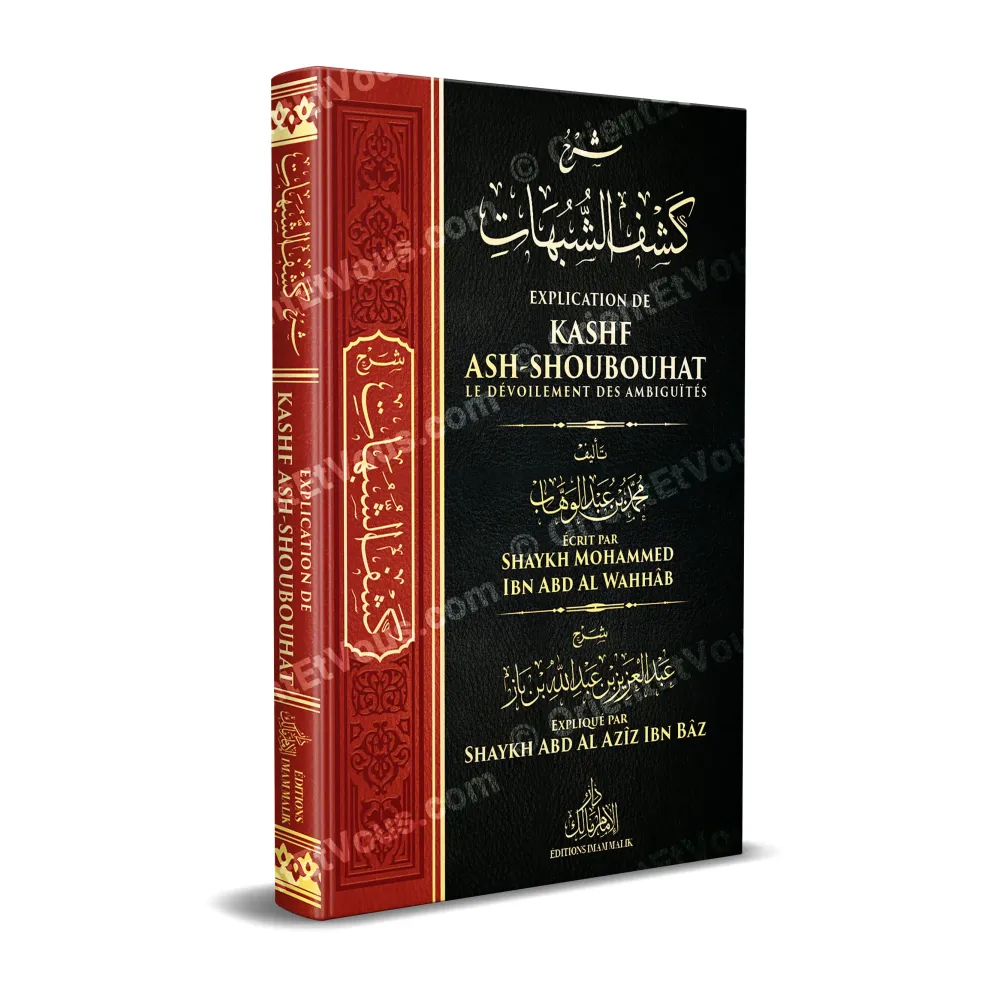


Explanation of Kashf ash-Shoubouhat by Abd al Aziz ibn Baz is a book in French that provides a structured clarification of doctrinal ambiguities related to Tawhid and the arguments leading to Shirk.
The book follows a pedagogical progression designed to help the reader identify these doubts, understand their underlying reasoning, and respond to them using clear principles and evidences.
Explanation of Kashf ash-Shoubouhat by Abd al Aziz ibn Baz is a book in French that provides a structured clarification of doctrinal ambiguities related to Tawhid and the arguments leading to Shirk.
The book follows a pedagogical progression designed to help the reader identify these doubts, understand their underlying reasoning, and respond to them using clear principles and evidences.
You might also like
![Explication de Kashf ash-Shoubouhât [Mohammed Ibn Ibrâhîm Al Ash-Shaykh]](https://orientetvous.com/5466-home_default/-french-shrh-kshf-alshbhat-mhmd-abrahym-al-alshykh.jpg)
![Mutûn Tâlib Al-'Ilm: La Dissipation des Équivoques [Format Poche - Bilingue]](https://orientetvous.com/7694-home_default/-french-arabic-kshf-alshbhat.jpg)
![Explication De l'épître: Le dévoilement des ambiguïtés [Al-Fawzan]](https://orientetvous.com/12706-home_default/-french-shrh-kshf-alshbhat-alfwzan.jpg)
![Commentaire de l'épître "La Dissipation des Ambiguïtés (Kachf ach-Chubuhât) [al-Fawzân]](https://orientetvous.com/13750-home_default/-french-shrh-kshf-alshbhat-alfwzan.jpg)
Explanation of Kashf ash-Shoubouhat is a structured commentary on the treatise devoted to unveiling the ambiguities surrounding Tawhid and the lines of reasoning that lead to shirk when presented as legitimate or “spiritual” practices. The book offers a methodical clarification of recurring confusions related to worship, relying on clear principles and established proofs in order to safeguard the purity of monotheism.
At the heart of this work lies the idea that authentic faith is not limited to a nominal affiliation or an abstract recognition of Allah’s Lordship. Rather, it requires exclusive worship and a decisive break from every form of association. Accordingly, the book stresses that Islam is a living reality made of belief, speech, and deeds, while warning against a religion emptied of meaning by ignorance, inherited habits, or practices adopted under a claim of drawing closer to Allah.
The book opens by placing the question of faith at the center of the religion. It reminds the reader that all messengers called to one truth: worship Allah alone and turn away from false devotions. However, it also shows that societies can fall again—under renewed forms—into behaviors akin to ancient idolatries, especially when ignorance and conformity prevail.
The first major section therefore presents the essence of Tawhid, then explains how certain ambiguities take shape. They often rely on honorable notions such as intercession, love of the righteous, seeking blessing, fear, or respect. Yet when they lead to directing acts of worship to other than Allah, they become a major source of doctrinal confusion.
A foundational theme is repeated throughout the Explanation of Kashf ash-Shoubouhat: the early polytheists acknowledged Allah’s Lordship while assigning partners in worship. The book therefore clarifies that recognizing creation, providence, or divine sovereignty is not sufficient to establish authentic monotheism.
Tawhid is fully realized through exclusive worship, sincere supplication, seeking aid, and placing hope in Allah alone. This distinction provides an essential benchmark for understanding why certain widespread practices contradict the requirement of pure monotheism.
A substantial part of the book addresses one of the most sensitive areas: intercession, calling upon the righteous, seeking help, and practices connected to graves. The work presents the common argument that these acts are only meant to draw closer to Allah or obtain spiritual mediation, then shows how they go astray when they amount to invoking other than Allah.
It also emphasizes that intercession is only valid within its legitimate framework, since it belongs to Allah alone. Any form of spiritual dependence on created beings leads to a confusion between due respect for the righteous and acts of worship that must be directed only to the Creator.
The overall structure alternates detailed thematic explanations with question-and-answer sections that bring the principles back to concrete situations. This method helps the reader identify innovations, distinguish a lawful precaution from a fear tied to shirk, and avoid shortcuts in religious judgments.
Thus, the discussions on fear show that it can be natural and justified, yet becomes problematic when it takes the form of an “occult” fear attached to created beings. The book then teaches how to examine such cases with rigor and discernment.
In the end, the Explanation of Kashf ash-Shoubouhat aims to protect faith by giving the reader a structured understanding of Tawhid and a real ability to respond to ambiguities with discernment. It is intended for those who want to strengthen their belief, correct practices inherited through habit, and return to worship that accords with the exclusive right of Allah.
In the same spirit of clarifying the foundations of faith, the reader may also benefit from Explanation of the Three Fundamentals, which follows a coherent educational approach grounded in texts and principles.

No customer reviews for the moment.
![L'explication des quatre bases [Abdou-Razzâq Al 'Abbad]](https://orientetvous.com/11480-home_default/-french-arabic-shrh-alqwad-alarb-bd-alrzaq-albad-albdr.jpg)
![3D cover of the book Explanation Talqīn Uṣūl al-ʿAqīda by Ibn Abd al-Wahhab explained by Abd ar-Razzaq al-Badr [French]](https://orientetvous.com/16323-home_default/initiation-to-belief.jpg)
![Commentaire de l'épître "La Vertu de l'Islam" [al-Fawzân]](https://orientetvous.com/13753-home_default/-french-shrh-fdl-alaslam-alfwzan.jpg)

![Sharh Kitâb at-Tawhîd: Explication de Kitâb at-Tawhîd [al-Fawzân]](https://orientetvous.com/10291-home_default/-french-almlkhs-fy-shrh-ktab-altwhyd.jpg)

![Le Commentaire du Livre Les Six Fondements [Abd Ar-Razzâq al-Badr]](https://orientetvous.com/11775-home_default/-french-shrh-alaswl-alstt-bd-alrzaq-bn-bd-almhsn-albdr.jpg)
![Comprendre l'attestation de foi lâ ilâh illâ Allah [Al-Fawzân]](https://orientetvous.com/5464-home_default/-french-shrh-tfsyr-klmt-altwhyd-alfwzan.jpg)

![Explication des trois Fondements [Al-'Uthaymîn]](https://orientetvous.com/4735-home_default/-french-shrh-thlatht-alaswl-llshykh-althymyn.jpg)
![Le commentaire du livre "Les 4 règles" [Al-Fawzân - Édition Bilingue]](https://orientetvous.com/6802-home_default/-french-arabic-shrh-alqwad-alarb-alfwzan.jpg)
![Le Commentaire des Trois Fondements d'Ibn Qasim [Français/Arabe]](https://orientetvous.com/11486-home_default/-french-arabic-tlyq-ly-thlatht-alaswl-m-hashyt-labn-qasm.jpg)


![Commentaire du livre Les Fondements de La Foi [Al-Fawzân]](https://orientetvous.com/12899-home_default/-french-shrh-aswl-alayman-alfwzan.jpg)