




- -10%
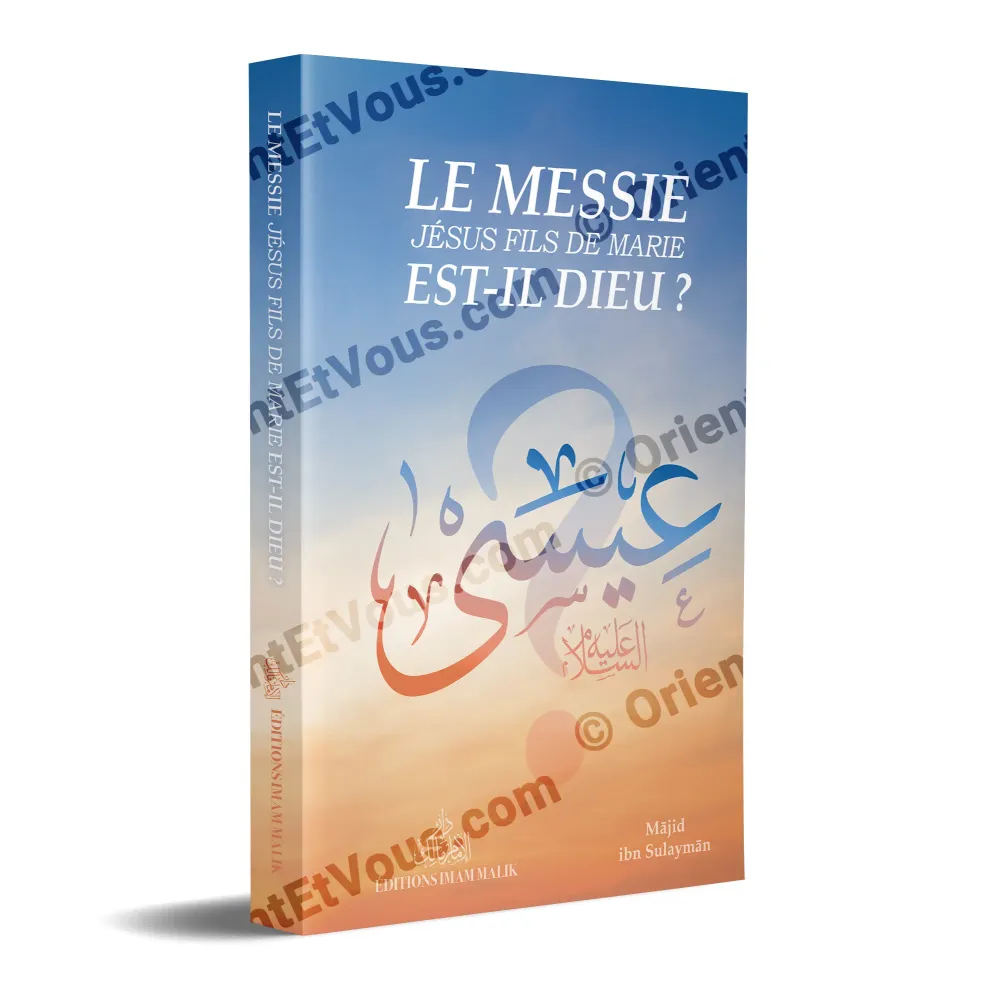


Is the Messiah God? is a book in French that examines the question of Jesus’ divinity through scriptural, rational, and historical arguments. It aims to clarify the status of the Messiah as a servant and Messenger of God, concluding with an affirmation of pure monotheism according to the Quran.
Is the Messiah God? is a book in French that examines the question of Jesus’ divinity through scriptural, rational, and historical arguments. It aims to clarify the status of the Messiah as a servant and Messenger of God, concluding with an affirmation of pure monotheism according to the Quran.
You might also like

Is the Messiah, Jesus Son of Mary, God? is a reflective and argumentative work that examines, in a structured way, the claim that Jesus the Messiah is God or the “Son of God.” The author develops a step-by-step approach intended to show that Jesus son of Mary is a human being and a messenger sent by God, not a divinity nor someone worthy of worship.
The book presents its research through “thirty aspects” that complete one another: scriptural, rational, and historical proofs, followed by a conclusion grounded in Qur’anic evidence. Thus, the argument draws on passages from the Old and New Testaments, logical reasoning, and historical analysis, before closing with the Qur’anic position regarding Jesus.
In its first axis, the author relies on scriptural elements to challenge the idea that Jesus claimed a divine nature or called to be worshipped. The aim is to return to an understanding of Jesus as a Prophet and Messenger, while distinguishing between the original message attributed to the Messiah and later theological formulations. Moreover, key expressions often invoked in debate are approached with attention to context and meaning.
The second chapter gathers rational proofs presented as accessible to “sound reason,” logic, and reflection. This section discusses the coherence of core claims tied to the deification of the Messiah, through an ordered and cumulative argument. Consequently, the progression is designed to guide the reader toward a conclusion presented as more consistent with God’s oneness and Jesus’ prophetic mission.
The third chapter adopts a historical perspective: it assigns a decisive role to Paul of Tarsus in introducing and spreading new beliefs, then examines the impact of episcopal councils supported by Roman authority in formalizing doctrines. In addition, the book follows a sequence of stages and decisions viewed as having transformed the original message, particularly regarding the Messiah’s divinity, the Trinity, and the question of Christ’s natures.
The fourth chapter presents Qur’anic proofs intended to affirm the falsity of the claim that the Messiah is a lord worthy of worship. Thus, the argument emphasizes the exclusive worship of Allah and the place of prophets—among them Jesus—as servants and messengers calling humanity to God’s oneness. In this perspective, Is the Messiah, Jesus Son of Mary, God? reaches a conclusion centered on monotheism and on the distinction between the Creator and His creation.
Finally, the book includes appendices bringing together various teachings: Qur’anic texts (including Al-Ikhlas and Ayat al-Kursi), an overview of Roman beliefs, an account related to Mary and Jesus, a clarification regarding the expression “Son of God,” as well as general points. The work also closes with “spiritual confidences,” adopting an exhortative tone and an invitation to Islamic faith, addressing especially those seeking clarity and a creed free from association. To explore this theme further, see Muslim–Christian Dialogue.
No customer reviews for the moment.
![Histoire de la croyance islamique [Couverture Souple]](https://orientetvous.com/5451-home_default/-french-alqydt-alaslamyt-wtarykhha.jpg)



![L'innovation [Al-Fawzan]](https://orientetvous.com/4750-home_default/-french-albdt-wbyan-anwaha-wahkamha.jpg)
![Book cover Mohammad between Negligence and Exaggeration by Ibn Baz [French book]](https://orientetvous.com/16113-home_default/mohammad-negligence-exaggeration-french.jpg)


![Cover of the book The Shia and the Sunnah – overview of the Shia and Sunnah relationship in Islam [French]](https://orientetvous.com/15977-home_default/shia-and-sunnah.jpg)