

- New
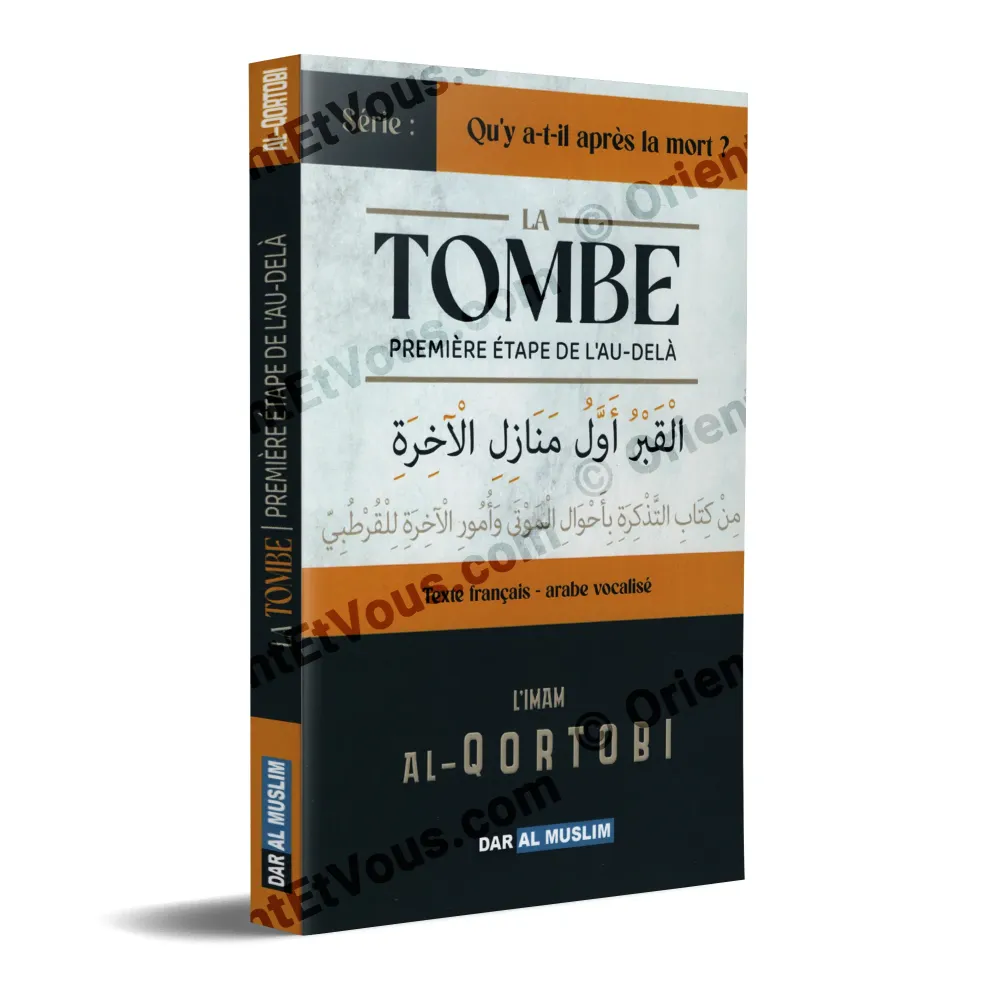


The Grave: The First Stage of the Hereafter – al-Qortobi [French/Arabic] is an extract from the encyclopedia At-Tadhkira bi-Ahwâl al-Mawtâ wa 'Umûr al-Âkhira, in which Imam al-Qortobi gathers the essential teachings on the grave, the first stage of the Hereafter, to help readers understand and prepare for this stage no one escapes.
Through authentic hadiths, explanations from scholars, and a fully vocalized Arabic text, this French/Arabic book helps readers understand the questioning of the grave, its trials, the believer's reward, and the importance of preparing for the life to come.
The Grave: The First Stage of the Hereafter – al-Qortobi [French/Arabic] is an extract from the encyclopedia At-Tadhkira bi-Ahwâl al-Mawtâ wa 'Umûr al-Âkhira, in which Imam al-Qortobi gathers the essential teachings on the grave, the first stage of the Hereafter, to help readers understand and prepare for this stage no one escapes.
Through authentic hadiths, explanations from scholars, and a fully vocalized Arabic text, this French/Arabic book helps readers understand the questioning of the grave, its trials, the believer's reward, and the importance of preparing for the life to come.
You might also like
![L’Édification dans les États des Morts et les Événements de l'Au-Delà [at-Tazkira]](https://orientetvous.com/9343-home_default/-french-altdhkrt-bahwal-almwty-wamwr-alakhrt.jpg)
![La mort et la vie dans la tombe [al-Qurtubî]](https://orientetvous.com/9817-home_default/-french-almwt-walqbr-alqrtby.jpg)
The Grave
The First Stage of the Hereafter
Imam al-Qortobi
The Grave – The First Stage of the Hereafter – al-Qortobi addresses a central concern of the belief in the Last Day: understanding what awaits the believer upon entering the grave. Imam al-Qortobi devoted a substantial part of his encyclopedia on the hereafter to this stage, describing it, from the founding hadith, as the first dwelling every human being encounters after death. This volume draws on the texts gathered in At-Tadhkira bi-Ahwâl al-Mawtâ wa 'Umûr al-Âkhira, one of the major references of the Islamic heritage devoted to eschatology and belief in the Last Day.
Readers will find a selection devoted exclusively to the realities of the grave. It covers its importance in the journey toward the hereafter, the trials associated with it, the questioning of the deceased, and the situation of the believer as opposed to one who has turned away from faith. The aim is simple: to make the essential teachings of an encyclopedic work accessible without losing their depth.
Al-Qortobi's original work spans three volumes, combining authentic reports, detailed chains of transmission, and advanced juristic discussions intended for a specialised readership. To make this content accessible without betraying its substance, the editor therefore retained only authentic hadiths and narrations carrying spiritual meaning. Redundant versions of the same events and digressions whose meaning is already conveyed through translation were left aside. Some of the poetry quoted by the author was nonetheless kept, particularly the verses recalling, before the earth of the grave, the equality of all people in death.
This edition is therefore not a mere translation of an ancient text: it offers readers a structured access to al-Qortobi's essential teachings, accompanied by the references and explanations needed to understand them. Each hadith is referenced directly to the collections of Bukhari and Muslim whenever possible, or supported by the authentication ruling of Shaykh Al-Albani for other sources. Necessary explanations draw on leading theological references such as Fath al-Bari by Ibn Hajar and Sharh Muslim by Nawawi, as well as the works of contemporary scholars such as Shaykhs Ar-Rajihi and Abu Adam al-Ithiopi. Qur'anic verses follow the translation of Rachid Maach, and the fully vocalised Arabic text benefits both Arabic speakers and learners of the language.
From the opening pages, readers encounter the account of Uthman ibn Affan, who wept until his beard was soaked whenever he stood before a grave, while remaining unmoved by mentions of Paradise and Hellfire. This scene illustrates the importance placed on reflecting upon the grave in the spiritual education of the earliest generations. Imam al-Qortobi then traces the origin of burial back to the Qur'anic account of Cain and Abel, before addressing practical matters: the proper form of a grave and the prohibition of ostentation in burial. He further recalls, regarding the choice of burial site, that no soil purifies or defiles in itself — only righteous deeds give a place its true worth.
The heart of the text is organised around the major themes of this doctrine. Each day, the grave addresses its occupant, describing itself as the "house of solitude". The trial of the grave's squeeze, the dhaghta, is illustrated through the case of Sa'd ibn Mu'adh: the Prophet stated that if anyone could have escaped it, it would have been him. This account underlines that no merit exempts a person from this first trial. The questioning by the two angels receives the most detailed treatment, through the hadith of al-Bara' ibn 'Azib, which paints two contrasting pictures: the soul of the believer, received with gentleness before a window onto Paradise is opened for it, and that of the disbeliever or the hypocrite, subjected to an entirely different trial.
An entire section further defends this doctrine against rationalist arguments that questioned its reality on the grounds that no traces were observable upon exhumation. The response draws on the nature of the soul itself and on analogies with sleep, firmly grounding the teaching within the framework of belief held by the pious predecessors. These accounts are therefore not mere information about the unseen: above all, they invite reflection on the consequences of deeds performed during earthly life, since wealth and status vanish with death, while deeds accompany a person into this first dwelling.
The text also devotes considerable attention to the concrete means of guarding against the difficulties of this stage: standing guard at the frontiers, dying in battle, regularly reciting protective surahs — notably Tabarak (Al-Mulk) — or dying on a Friday or the night preceding it. A particular reflection addresses the fate of martyrs, whose bodies, as several reported accounts confirm — including that of the martyrs of Uhud, found intact more than forty years later — are preserved from decay.
Practical matters are not overlooked either. The book addresses the words to be said when laying the deceased in the grave and the recommendation to remain briefly after burial to pray for their steadfastness during questioning. It also mentions the practice of reminding the deceased of the words of faith right after the grave is closed. The text concludes with the various forms taken by the punishment of the disbeliever, notably through the well-known hadith of the two graves punished for gossip and for negligence regarding purification after urinating.
In accordance with the editorial approach of the collection, this volume does not develop in detail the circumstances of the agony of death itself, nor the collective resurrection, the final judgement, the description of Paradise and Hell, or the signs of the end of time. These themes, reserved for the other volumes of the series, appear here only insofar as they shed light on the fate of the soul during the interval separating it from these events.
This volume is indeed the second in a five-part collection, designed to guide the reader progressively through the major stages of the hereafter: death, the grave, the resurrection, Hell and Paradise, and finally the signs of the end of time. Each volume is dedicated to a specific stage, allowing its teachings to be explored in depth without dispersing the reader's attention.
The value of this book lies in the combination of two qualities rarely found together: faithfulness to a classical reference of Islamic eschatology, and a presentation designed for a non-specialist readership. Authenticated and rigorously referenced hadiths, explanations supported by recognised theological sources, careful translation, and a fully vocalised Arabic text — every editorial choice aims to make this content genuinely usable, without diluting its depth.
The grave remains a stage no one can escape. By recalling its realities, its trials, and the means of preparing for it, this book encourages, from this very moment, the strengthening of faith and the improvement of one's deeds — a work of substance as much as a personal reminder, thoroughly documented and directly relevant to the reader's life.
Who is the author of this book?
The text is drawn from the encyclopedia of al-Qortobi, a recognised scholar of Islamic eschatology, who gathered teachings on the grave from the Qur'an, the hadiths, and the sayings of the earliest generations.
Does this book include the Arabic text?
Yes. This bilingual edition presents a fully vocalised Arabic text alongside the French translation, making it useful both for Arabic speakers and for learners of the language.
Is this a complete translation of the original work?
No. This is a focused selection of the essential teachings, leaving aside the detailed chains of transmission and the advanced discussions intended for a specialised readership.
Do I need to read the first volume before this one?
It is not essential. Each volume in the series covers a distinct stage and can be read independently, even though the order of the collection follows the natural progression of the stages of the hereafter.
Who is this book for?
For any reader wishing to deepen their understanding of belief in the Last Day, whether discovering the subject for the first time or seeking a reliable synthesis of authentic texts, with no prior theological knowledge required.

No customer reviews for the moment.
![Le Grand Livre de la Résurrection et du Jugement Dernier [al-Qurtubî]](https://orientetvous.com/9823-home_default/-french-albth-walywm-alqyamt-alqrtby.jpg)



![Les signes de l'Heure [Al-Fawzan]](https://orientetvous.com/4463-home_default/-french-ashrat-alsat-alfwzan.jpg)
![Les Délices du Paradis [Ibn Kathîr]](https://orientetvous.com/4012-home_default/-french-wsf-aljnt-wmafyha-mn-nym.jpg)
![Le Paradis [al-Qurtubî]](https://orientetvous.com/9951-home_default/-french-aljnt-wma-ja-fyha-wfy-sftha-wnymha-alqrtby.jpg)

![La vie après la mort [Al-Fawzan]](https://orientetvous.com/4464-home_default/-french-alhyat-bd-almwt.jpg)
![Le faux Messie [Ar-Râjihî]](https://orientetvous.com/5902-home_default/-french-almsyh-aldjal.jpg)