
- New
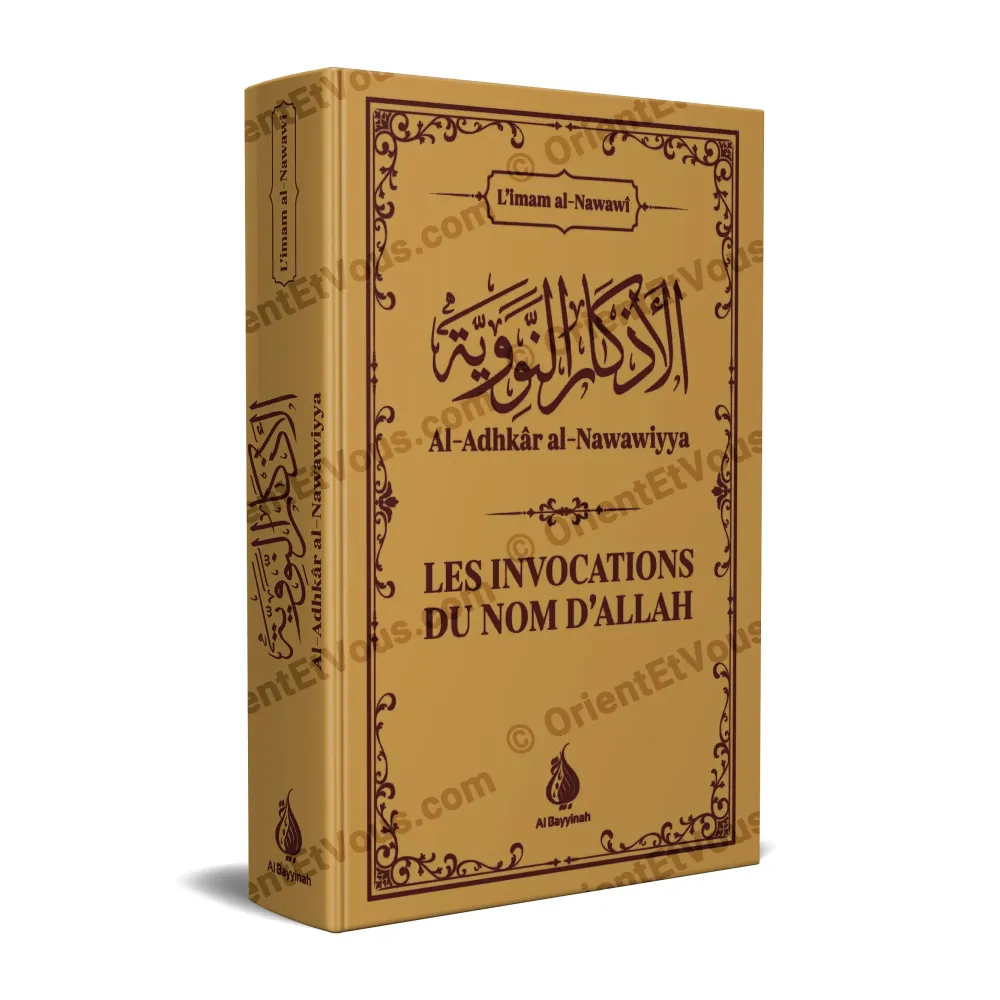


The Invocations of the Name of Allah by al-Nawawi is a reference work dedicated to supplications and dhikr, systematically compiling formulas from major hadith sources to guide the Muslim in daily life (French book).
This book offers a structured and accessible approach to the remembrance of Allah, covering acts of worship, everyday situations and inner states, while indicating the authenticity of hadiths and encouraging consistent spiritual practice.
The Invocations of the Name of Allah by al-Nawawi is a reference work dedicated to supplications and dhikr, systematically compiling formulas from major hadith sources to guide the Muslim in daily life (French book).
This book offers a structured and accessible approach to the remembrance of Allah, covering acts of worship, everyday situations and inner states, while indicating the authenticity of hadiths and encouraging consistent spiritual practice.
You might also like

![Le livre des Invocations [an-Nawawî - Bilingue]](https://orientetvous.com/13250-home_default/-french-arabic-aladhkar-llamam-alnwwy.jpg)
Al-Adhkar al-Nawawiyya
Imam al-Nawawi
Format: 17 x 24 cm
Number of pages: 930
Language: French
The Invocations of the Name of Allah by al-Nawawi — known in Arabic as Al-Adhkar al-Nawawiyya — is one of the most famous works of Imam al-Nawawi. This French book is devoted to invocations, formulas of remembrance of Allah and the spiritual conduct of the Muslim throughout the different moments of life. Its full title, The Adornment of the Righteous and the Emblem of the Virtuous in Summarizing the Recommended Invocations and Formulas of Dhikr by Night and Day, clearly reflects the purpose of the work. It gathers, in a methodical and accessible way, invocations and formulas of divine remembrance reported in the major hadith sources. Thus, the book covers a wide range of situations in the believer’s life.
The stated objective of Imam al-Nawawi is to make transmitted invocations easier to access, so that the reader can know what to say, practise these formulas and find them easily according to each situation. The author explains that he wished to compose a useful book for worshippers, clear for beginners as well as advanced students. He also indicates the degree of each hadith: authentic (sahih), good (hasan), weak (da'if) or rejected (munkar). Therefore, this book is not merely a collection of invocations. It presents a true method of spiritual life, grounded in the sources and applicable in daily practice.
What distinguishes this work from simple prayer collections is the comprehensive vision that shapes the entire book. Imam al-Nawawi does not merely transmit texts. He aims to guide the reader toward a regular and conscious practice of dhikr, connecting each daily action to the presence of Allah. The structure begins with essential foundations: the value of dhikr, its conditions, its recommended manners, and the place of the heart and tongue. It then develops into numerous chapters arranged according to the situations of life. Moreover, the balance between spirituality, hadith scholarship, jurisprudence and pedagogy gives this work rare depth within Islamic literature devoted to invocations.
The book covers a wide range of situations structured around the major moments of the believer’s life. Daily and domestic life is addressed through formulas for waking up, dressing, entering and leaving the home, ablution and natural needs. Worship occupies a central place: dhikr in the mosque, invocations related to the call to prayer and formulas recited in each position of the prayer. Added to this are the morning and evening adhkar, those of Friday, the two Eids, fasting, the Night of Decree (laylat al-qadr) and i'tikaf. In addition, moments of vulnerability are carefully treated: going to sleep, insomnia, nightmares and waking during the night. Social relations, meals, marriage, birth, mourning and visiting graves are also covered in dedicated chapters.
The work also devotes important sections to difficult inner states: invocations in times of anxiety, sadness, adversity and illness, as well as certain situations related to natural phenomena. Travel is also taken into account, with formulas specific to each stage of the journey and to particular situations such as istikhara. Furthermore, a remarkable section is devoted to the ethics of speech: backbiting (ghiba), slander (namima), lying, and the recommendation of good speech and consultation. Finally, unrestricted dhikr, the Most Beautiful Names of Allah (asma al-husna), sending blessings upon the Prophet and the conditions of invocation (adab al-dua) complete this wide panorama.
The Invocations of the Name of Allah by al-Nawawi is widely regarded as one of the foundational references in the field of invocations and daily Islamic practice. Intended for both beginners and advanced students, this work accompanies the Muslim in daily worship. It educates the heart and organizes the believer’s relationship with Allah through invocations that are either authenticated or whose degree is indicated. Through its clarity, rigor and depth, it remains, centuries after its composition, a spiritual guide of lasting relevance.

No customer reviews for the moment.

![La Citadelle du Petit Muslim [Livre Illustré]](https://orientetvous.com/8781-home_default/-french-hsn-almslm-alsghyr.jpg)

![99 Names of Allah from the Qur’an and the Sunnah [French]](https://orientetvous.com/16116-home_default/99-names-allah-quran-sunnah-french.jpg)
![L'invocation qui n'est jamais rejetée [Edition Bilingue]](https://orientetvous.com/13721-home_default/-french-arabic-aldaʾ-aldhy-la-yrd.jpg)

![Sahîh Al-Adhkâr "L'Authentique des Rappels" [Format Poche - Bilingue]](https://orientetvous.com/9271-home_default/-french-arabic-shyh-aladhkar-mn-ktb-allamt-alalbany.jpg)
![Les Invocations Et Le Dhikr Du Prophète [Ibn Qayyim]](https://orientetvous.com/15146-home_default/-french-hdy-alnby-sly-allh-lyh-wslm-fy-aladhkar-waladyt-abn-qym.jpg)