




- New
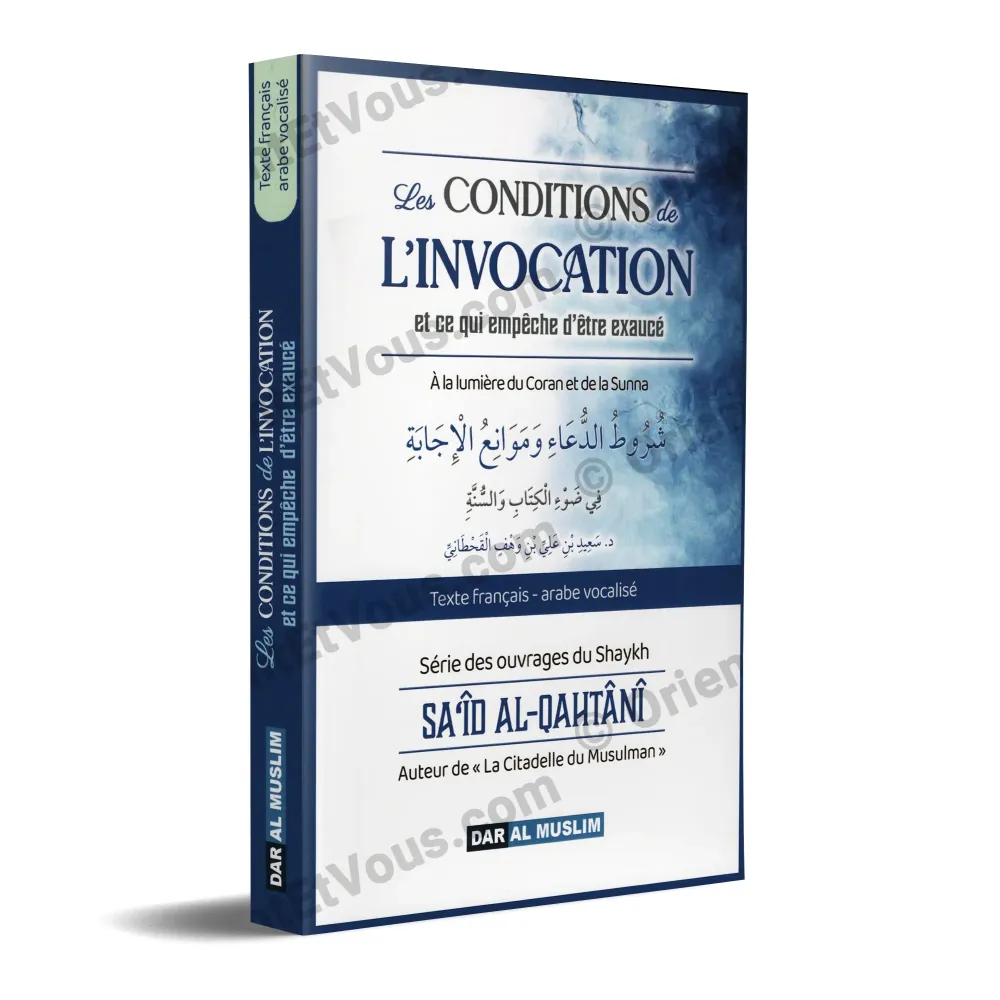


The Conditions of Supplication and What Prevents It From Being Answered by Sa'id al-Qahtani is a French/Arabic book that explains, in the light of the Quran and the Sunnah, the foundations of du'a, the conditions for its acceptance and the causes that may prevent it from being answered.
The book also explores the etiquette of supplication, the most favorable times and situations for acceptance, the supplications of the Prophets and the essential requests every Muslim should direct to Allah in order to strengthen faith and worship.
The Conditions of Supplication and What Prevents It From Being Answered by Sa'id al-Qahtani is a French/Arabic book that explains, in the light of the Quran and the Sunnah, the foundations of du'a, the conditions for its acceptance and the causes that may prevent it from being answered.
The book also explores the etiquette of supplication, the most favorable times and situations for acceptance, the supplications of the Prophets and the essential requests every Muslim should direct to Allah in order to strengthen faith and worship.
You might also like

![L'invocation qui n'est jamais rejetée [Edition Bilingue]](https://orientetvous.com/13721-home_default/-french-arabic-aldaʾ-aldhy-la-yrd.jpg)
Sa'id al-Qahtani
(author of "The Fortress of the Muslim")
The Conditions of Supplication and What Prevents It From Being Answered by Sa'id al-Qahtani is a study devoted to du'a, in the light of the Qur'an and the Sunnah. This book does more than present supplications to recite. It explains their true place in the life of a Muslim. Supplication appears here as an act of worship in its own right, with its own rules and conditions of acceptance. Several behaviours and situations can also prevent it from being answered. The believer thus gains a clearer understanding and a practice in line with revealed teachings.
The book follows a progressive approach from beginning to end. After defining the reality of du'a, the author sets out its merit, then details the conditions essential to its acceptance. He then draws attention to the obstacles that may deprive the servant of an answer. Finally come many practical teachings: etiquette, favourable times, examples of the prophets, and the essential requests for a believer's life.
The author first recalls what supplication truly is. Du'a is presented as the request the servant addresses to Allah with hope, humility and trust. Yet its scope goes beyond the mere utterance of words. It is closely linked to the remembrance of Allah and the acknowledgement of His favours. It also relates to the praise due to Him and the knowledge of His names and attributes. Supplication thus becomes the expression of the believer's total dependence on his Lord.
This book also distinguishes two complementary forms of du'a. The first is supplication through worship, which encompasses all deeds performed in hope of Allah's reward and out of fear of His punishment. The second is supplication through request, by which the servant directly asks for a benefit, healing, forgiveness or protection from harm. This distinction clarifies an essential principle: requests belonging exclusively to divine power must be addressed to Allah alone.
Furthermore, the author highlights the exceptional merit of du'a. The texts of the Qur'an and the Sunnah show that it is one of the noblest acts of worship. To supplicate Allah is to acknowledge His power, His generosity and His closeness to His servants. Du'a is also one of the most powerful means of obtaining good or warding off hardship. Its effectiveness, however, depends on several factors, which the author examines in detail.
This section presents the main conditions that favour the acceptance of supplication. The first is sincerity. The servant must purify his intention of any ostentation, any desire for recognition, or any orientation toward other than Allah. Every supplication must also conform to the teachings of the Messenger of Allah ﷺ. Like any act of worship, it is only accepted when performed with a sincere intention and in accordance with the Sunnah.
The book then stresses the complete trust the believer must place in his Lord. Whoever supplicates Allah does so with the certainty that He is able to answer any request in keeping with His wisdom. This trust is accompanied by presence of heart, deep hope, and true humility. Supplication cannot be reduced to words repeated mechanically. It requires an attentive heart, aware of its constant need for Allah.
Finally, the believer is called to show resolve in his request. He should neither hesitate nor doubt Allah's ability to answer his supplication. This trust, combined with sincerity and adherence to the prophetic way, forms one of the essential foundations on which the acceptance of du'a rests.
Having set out the conditions favouring the acceptance of du'a, the author turns to the causes that may prevent it from being answered. This approach helps the reader understand an essential point: supplication does not depend solely on the words spoken. It also depends on the state of the heart, daily conduct, and adherence to revealed teachings. The believer is thus invited to examine his own situation before assuming his supplication has gone unanswered.
One of the first obstacles mentioned is the consumption of unlawful things. Food, drink, clothing or income derived from haram can constitute a major barrier to an answer. Even when several favourable factors are present, such as travel, distress or persistence in du'a, persisting in what is unlawful can deprive the servant of the response he hopes for.
Haste is also among the most common obstacles. Many give up supplicating after feeling their request has taken too long to be answered. The book instead teaches patience. Allah may delay the answer for a wisdom the believer does not immediately perceive. He may also grant something better, or ward off, through that very supplication, a harm the servant was unaware of.
Sins, disobedience, neglecting religious obligations, and supplications involving the severing of family ties are also presented as causes that may prevent an answer. The author therefore encourages sincere repentance, restoring the rights of others, and reforming one's conduct, so that supplication is accompanied by genuine rectitude.
This chapter gives considerable attention to the etiquette accompanying du'a. It recommends beginning by praising Allah, then invoking blessings upon the Prophet ﷺ before making one's request, and concluding in the same manner. This practice is rooted in the prophetic tradition. It reminds us that supplication is, above all, an act of worship.
The believer is also encouraged to supplicate Allah both in ease and in hardship. One should show humility and speak with moderation. Persistence in one's request remains permissible, provided the limits set by the religion are not transgressed, while maintaining constant trust in one's Lord. The author also stresses the importance of supplicating Allah by His most beautiful names, acknowledging His favours, recognising one's own faults, and expressing one's need for Him with sincerity.
Among the means that favour an answer are also performing ablution when possible, facing the qibla, raising the hands, tears inspired by fear of Allah, as well as recalling a deed sincerely performed. The text finally stresses the importance of beginning by supplicating for oneself, then for one's relatives and for all believers, while avoiding requests contrary to the teachings of the Qur'an and the Sunnah.
This chapter then gathers many moments during which supplication is especially recommended: the last third of the night, prostration, the interval between the call to prayer and its establishment, Friday, the month of Ramadan, the day of 'Arafah, the breaking of the fast, and the Night of Decree. Several particular circumstances are also mentioned, such as rainfall, times of distress, or gatherings devoted to the remembrance of Allah. The believer is encouraged to supplicate abundantly during these times.
To illustrate these teachings, the author reports numerous examples drawn from the lives of the prophets. The supplications of Adam, Noah, Abraham, Moses, Joseph, Jonah, Zachariah and Job show how Allah responds to His servants according to His wisdom. These accounts highlight the patience, trust, repentance and sincerity that characterise the supplications of the best of believers.
Several supplications reported from the Prophet Muhammad ﷺ are also presented, along with situations experienced by his Companions. These examples give a practical dimension to the rules set out earlier. They show how the teachings of the Qur'an and the Sunnah can be applied in daily life, and prepare the reader to direct his own requests toward what is truly beneficial for his religion and his life to come.
This section continues with several categories of people whose supplication carries a promise or a strong hope of being answered, according to the texts of the Qur'an and the Sunnah. Among those mentioned are the Muslim who supplicates for his absent brother, the person wronged by injustice, the traveller, the fasting person, the just ruler, and one who finds himself in genuine need. These examples remind us that being answered is linked to Allah's wisdom, as well as to the sincerity of the need expressed by the servant.
The author also mentions several particular supplications reported in the prophetic tradition, such as those said upon waking at night, the supplication of Yunus (Jonah), the words recommended during hardship, and the supplication addressed to Allah by His Greatest Name. Through these many examples, the reader discovers practical ways to enrich his practice of du'a while remaining faithful to authentic teachings.
The book does not merely explain how to supplicate Allah. It also guides the believer toward what he should ask for first. The servant depends entirely on his Lord for his faith, his sustenance, his protection and his salvation. This is why requests related to guidance, forgiveness of sins, steadfastness in religion, entry into Paradise, protection from overwhelming trials, and the preservation of blessings occupy a central place throughout the book.
This guidance gives the reader a balanced view of supplication. Rather than limiting his requests to material concerns, he learns to prioritise what strengthens his relationship with Allah and prepares his success in the Hereafter. Du'a thus becomes a permanent expression of faith, hope, trust and servitude toward the Creator.
Through its methodical progression, this book offers a complete understanding of supplication based on evidence from the Qur'an and the Sunnah. It defines the true meaning of du'a and sets out the conditions for its acceptance. It then warns against the obstacles to being answered, details the rules of etiquette, and gathers the most favourable times. These teachings are finally illustrated through the supplications of the prophets and numerous examples drawn from the prophetic tradition, allowing the reader to put them into practice immediately.
To complement this study devoted to the conditions and rules of du'a, the reader may also discover The Art of Dhikr and Supplication, which explores more broadly the authentic remembrances and supplications reported in the Qur'an and the Sunnah.
More than a simple collection of supplications, The Conditions of Supplication and What Prevents It From Being Answered helps the believer understand how to make du'a a sincere act of worship, in accordance with the Qur'an and the Sunnah. Through its methodical approach and its many proofs, it stands as a valuable guide to strengthening one's relationship with Allah and giving deeper meaning to every supplication.

No customer reviews for the moment.

![Les mérites de l’invocation ['Abd Ar-Razzâq al-Badr]](https://orientetvous.com/12229-home_default/-french-aldaʾ-mnzlth-wadabh.jpg)
![L'authentique des invocations pour les enfants [Version Garçon]](https://orientetvous.com/7033-home_default/-french-arabic-shyh-aladyt-llatfal-nskht-alsby.jpg)

![Les Invocations du Matin et du Soir [Raslan]](https://orientetvous.com/1853-home_default/-french-arabic-adhkar-alsbah-walmsa-rslan.jpg)
![Les Invocations Et Le Dhikr Du Prophète [Ibn Qayyim]](https://orientetvous.com/15146-home_default/-french-hdy-alnby-sly-allh-lyh-wslm-fy-aladhkar-waladyt-abn-qym.jpg)




![Black cover of The Fortress of the Muslim by Sa'îd al-Qahtânî [French book] – Al Bayyinah Edition](https://orientetvous.com/16393-home_default/fortress-of-the-muslim-said-al-qahtani.jpg)
![Les Invocations du matin et du soir [Bark Abou Zayd]](https://orientetvous.com/4160-home_default/-french-adhkar-trfy-alnhar.jpg)
![La Citadelle du Musulman [Arabe/Français/Phonétique]](https://orientetvous.com/9894-home_default/-french-arabic-transliteration-hsn-almslm.jpg)