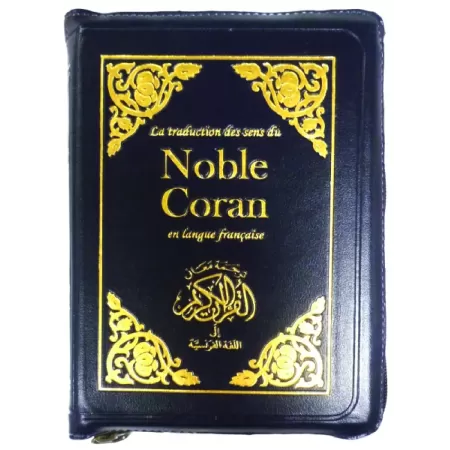


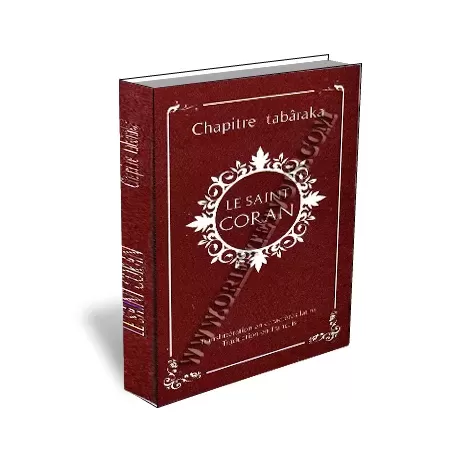
The Quran – Translation of the Meanings of Its Verses – Tawbah is a French-only edition based on a defined exegetical methodology, aiming to convey to French-speaking readers the primary meanings of the verses in light of classical commentary. This translation does not offer a purely literal rendering but relies on a synthesized approach drawn from the exegesis of Ibn Kathir. (French book)
Particular care is given to theological passages, the Names and Attributes of Allah, and areas of interpretative divergence, with explanatory notes provided where clarification is needed. The work therefore serves as a structured tool for understanding the Quran in French within a clearly defined doctrinal framework. (French book)
The Quran – Translation of the Meanings of Its Verses – Tawbah is a French-only edition based on a defined exegetical methodology, aiming to convey to French-speaking readers the primary meanings of the verses in light of classical commentary. This translation does not offer a purely literal rendering but relies on a synthesized approach drawn from the exegesis of Ibn Kathir. (French book)
Particular care is given to theological passages, the Names and Attributes of Allah, and areas of interpretative divergence, with explanatory notes provided where clarification is needed. The work therefore serves as a structured tool for understanding the Quran in French within a clearly defined doctrinal framework. (French book)
You might also like
![Le Coran: Traduction d'après les Exégèses de Référence [Version Hafs]](https://orientetvous.com/12869-home_default/alqran-alkrym-wtrjmt-manyt-aly-allght-alfrnsyt-brwayt-hfs.jpg)
![Traduction en français du précis d'exégèse du Noble Coran [al-Mukhtasar fi Tafsîr]](https://orientetvous.com/14517-home_default/-french-almkhtsr-fy-tfsyr-alqran-alkrym.jpg)
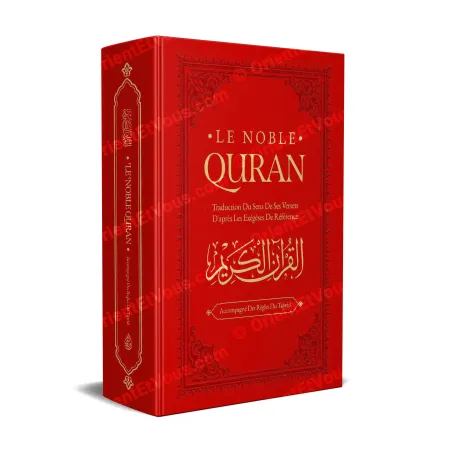
The Quran with the translation of the meaning of its verses by Tawbah Editions offers a French-only edition built on an explicitly exegetical methodology. It is not presented as a simple linguistic transfer of the Arabic text. Rather, it delivers a translation of meaning, developed in light of major works of Muslim Qur’anic exegesis.
From the outset, the project stems from a critical observation regarding certain existing French translations, which may appear fragmented or insufficiently contextualized. Thus, the work maintains that a faithful understanding of the Quran requires an explanatory mediation. Translating entails clarifying context, doctrinal scope, and the internal coherence of the verses.
Consequently, French-speaking readers are guided toward the prevailing meaning upheld by the scholarly tradition. In addition, the book clearly distinguishes the revealed Arabic wording from the translation of its meaning, in order to avoid confusion.
The adopted methodology follows on from the translation of Ibn Kathir’s exegesis. This edition serves as a condensed presentation of that reference work. In this perspective, The Quran with the translation of the meaning of its verses by Tawbah Editions most often summarizes the preponderant view reported by Ibn Kathir.
The presentation remains clear and concise. However, when other exegetical positions help clarify meaning, they are indicated in notes.
The translation does not claim to convey more than one facet of the possible meanings of each verse. Moreover, causes of revelation, rules of abrogation, and variant readings are mentioned when they provide meaningful insight. Finally, the text is arranged according to semantic units drawn from the reference exegesis to preserve coherence.
The work explicitly adopts the understanding of ahl al-sunna wa’l-jama‘a regarding the Names and Attributes of Allah. All verses connected to this field are translated in accordance with that creed. Thus, doctrinally sensitive passages receive consistent treatment grounded in early transmissions. The Divine Names are rendered into French to convey an approximate meaning, while directing readers to fuller explanations in an appendix.
Furthermore, the decision to retain the term “Allah” rather than translating it as “God” is deliberate. It aims to preserve the specificity of the proper Divine Name and to avoid theological ambiguities. In this regard, the same rigor appears in the handling of major formulas such as “Bismillah ar-Rahman ar-Rahim,” whose linguistic and exegetical nuances are examined before adopting a French rendering.
Particular care is given to passages relating to the Divine Attributes. The example of the Verse of al-Kursi illustrates this approach. The term al-kursi is translated according to the interpretation adopted by the reference exegetes, relying on reports from the Companions and early scholars. Therefore, figurative readings that conflict with the cited consensus are set aside.
Where needed, explanatory notes accompany the translation. They help prevent doctrinal confusion and clarify interpretive issues. Thus, readers benefit from a clear framework for approaching delicate passages without losing the overall coherence of meaning.
Beyond its scholarly dimension, The Quran with the translation of the meaning of its verses by Tawbah Editions is presented as a spiritual endeavor. The foreword highlights a keen awareness of the responsibility involved in translating the Book of Allah. The project is described as demanding, carried out with reverence and reliance upon Allah.
The stated aim is twofold: to provide clear access to the meaning of the verses and to restore the central place of the Sunnah and exegesis in understanding the Quran. Hence, this French-only edition is intended for readers seeking a structured translation guided by a defined methodology.
In conclusion, this work stands at the intersection of translation and exegesis. It offers a coherent French rendering that follows the broad lines of classical exegesis. Moreover, it maintains the distinction between the revealed Arabic text and the translation of its meaning, making it a solid tool for study and understanding.

No customer reviews for the moment.
![LE NOBLE CORAN - Edition Bilingue de luxe Rose Clair [Arabe/Français]](https://orientetvous.com/11417-home_default/-french-arabic-alqran-alkrym-mjld-fakhr-zhry-fath.jpg)
![Le Saint Coran [Arabe/Français - Format Poche]](https://orientetvous.com/4959-home_default/-french-arabic-alqran-alkrym-hjm-jyb.jpg)
![Chapitre 'Amma [Arabe-Français-Phonétique]](https://orientetvous.com/7890-home_default/-french-arabic-jz-m.jpg)
![LE NOBLE CORAN et la traduction en langue française de ses sens [Arabe/Français - Format Moyen]](https://orientetvous.com/11378-home_default/-french-arabic-alqran-alkrym-wtrjmt-manyh-aly-allght-alfrnsyt-hjm-mtwst.jpg)
![LE NOBLE CORAN - Edition Bilingue de luxe Bleu [Arabe/Français]](https://orientetvous.com/11405-home_default/-french-arabic-alqran-alkrym-mjld-fakhr-azrq.jpg)
![LE NOBLE CORAN et la traduction en langue française de ses sens [Arabe/Français - Très Grand Format]](https://orientetvous.com/11421-home_default/-french-arabic-alqran-alkrym-wtrjmt-manyh-aly-allght-alfrnsyt-hjm-kbyr-jyda.jpg)
![Le Saint Coran: Chapitre 'Amma [Français-Arabe-Phonétique]](https://orientetvous.com/10425-home_default/-french-arabic-transliteration-jz-m.jpg)
![Le Coran: Traduction d'après les Exégèses de Référence [Version Warsh]](https://orientetvous.com/12722-home_default/alqran-alkrym-wtrjmt-manyt-aly-allght-alfrnsyt-brwayt-wrsh.jpg)
![LE NOBLE CORAN - Edition Bilingue de luxe Rose [Arabe/Français]](https://orientetvous.com/11411-home_default/-french-arabic-alqran-alkrym-mjld-fakhr-zhry.jpg)